How to Read Periodic Table of Elements
The different elements are organized and displayed in the periodic table. Devised past Russian chemist Dmitri Mendeleev (1834–1907) in 1869, the tabular array groups elements that, although unique, share certain chemic properties with other elements. The backdrop of elements are responsible for their physical country at room temperature: they may be gases, solids, or liquids. Elements also have specific chemical reactivity, the ability to combine and to chemically bond with each other.
In the periodic table, shown in Figure 1, the elements are organized and displayed according to their atomic number and are arranged in a serial of rows and columns based on shared chemical and physical backdrop. In addition to providing the diminutive number for each element, the periodic table also displays the element'southward atomic mass. Looking at carbon, for example, its symbol (C) and proper noun appear, likewise as its atomic number of half-dozen (in the upper left-hand corner) and its atomic mass of 12.11.
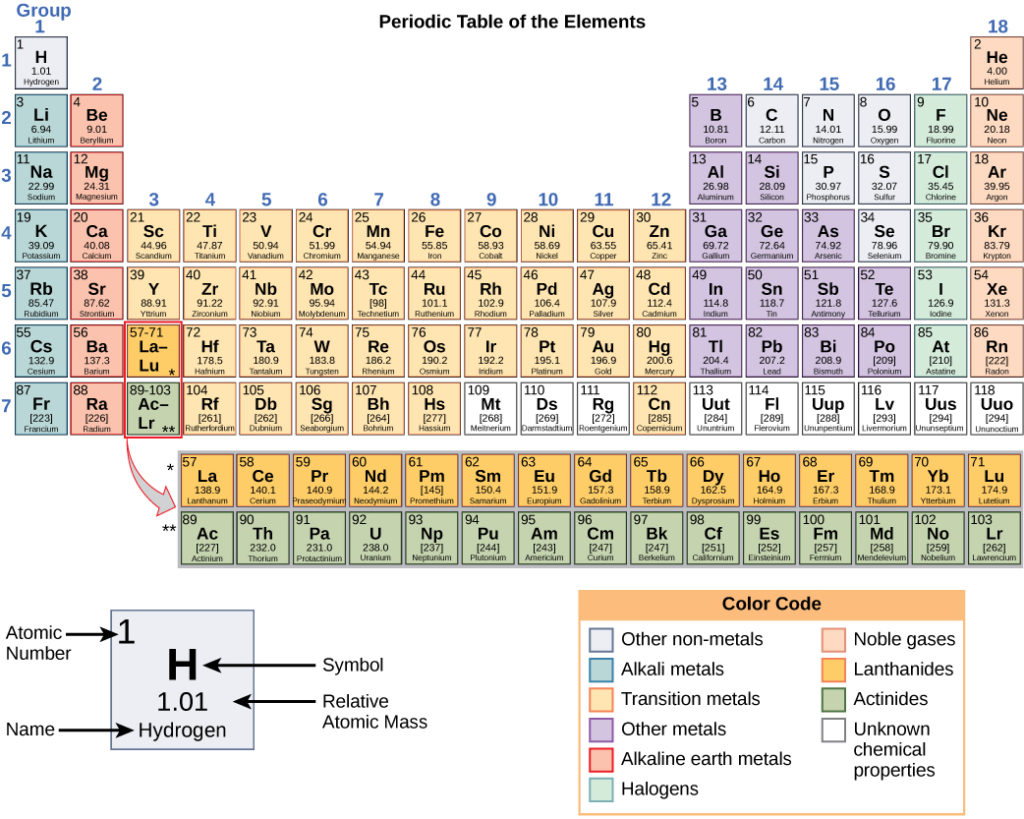
Figure 1. The periodic table shows the atomic mass and atomic number of each element. The diminutive number appears above the symbol for the element and the judge atomic mass appears below it.
The periodic table groups elements according to chemical properties. The differences in chemical reactivity between the elements are based on the number and spatial distribution of an cantlet's electrons. Atoms that chemically react and bond to each other grade molecules. Molecules are only two or more than atoms chemically bonded together. Logically, when two atoms chemically bond to form a molecule, their electrons, which form the outermost region of each atom, come up together first as the atoms form a chemic bail.
Scout this video for a more in-depth introduction to the periodic tabular array:
Source: https://courses.lumenlearning.com/bio1/chapter/reading-the-periodic-table-of-elements/

Postar um comentário for "How to Read Periodic Table of Elements"